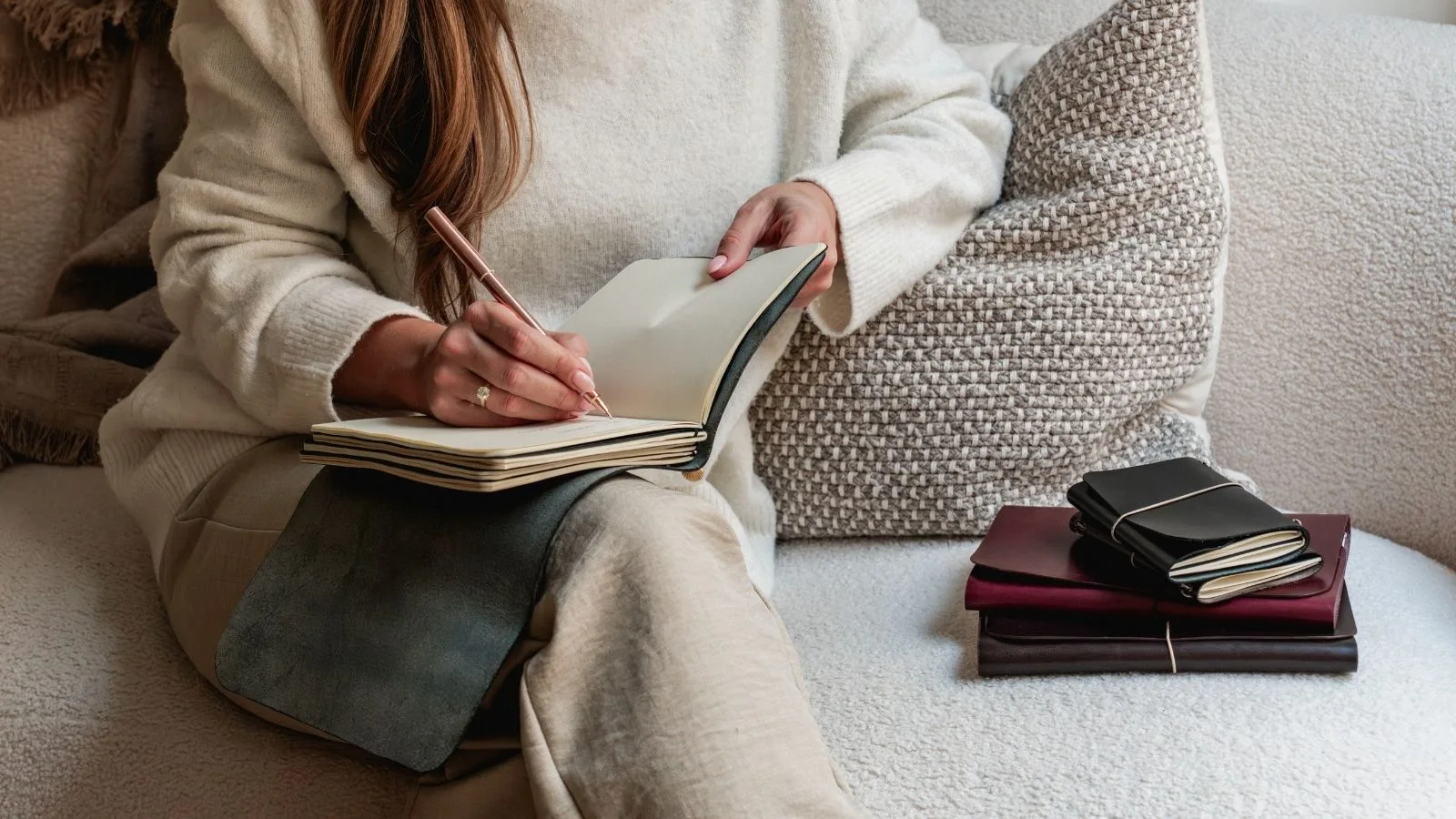
A leather journal is a very personal object. It is there when you start your day, it stays on your desk while you work, it travels in your bag or suitcase, it holds quick notes and also thoughts you would not always say out loud.
When you choose a notāre, you are not simply picking a notebook. You are choosing an object that will be present in many everyday moments. Customising it is how you make it truly yours, so that what you see on the outside fits what is happening inside.
In this article we walk through how to customise your notāre leather journal, following the same order you will find on the product page: first the format, then the cover colour, the elastic colours, the embossing, and finally the charms and small details.
What it really means to customise your leather journal
When we talk about a customised leather journal, it is not only about choosing a colour you like or adding initials.
In notāre, your journal is a system that can evolve with you:
- A leather cover that will stay with you for years.
- Inner refills you can change as you fill them or as your needs change.
- Elastic cords that hold everything together and also express your style.
- Embossing that gives a name or intention to what you are going to write.
- Charms that work as small talismans.
Customising your journal is about how you want to use it and how you want to feel when you open it: presence, purpose, and room to create.
Step 1: choose your format – Muse A5 or Nomad passport size
Before you think about colours or details, the most important decision is which format fits you best right now.
Muse: A5 journal to keep everything in one place
Muse is the A5 format, the classic desk notebook that still fits in many work bags and backpacks.
It works especially well if:
- You want one main notebook where work and personal life can live together.
- You write long texts, make big to-do lists or like having plenty of space on the page.
- You are drawn to weekly overviews, broader planning and pages where you never feel short of room.
An A5 leather journal is ideal if you picture yourself writing at your desk, in the kitchen with a coffee, or keeping it by your bedside to close the day.
Nomad: passport-size journal to carry everywhere
Nomad is the passport-size format: compact, light, designed to be with you all day.
It makes sense if:
- You want a companion for your pocket or a small bag.
- Its main role is to capture quick ideas, short notes, travel memories.
- You need something that does not weigh much and that you can take out in a café, on the train or on a plane.
A personalised travel notebooklike Nomad is perfect if you like moving around, writing outside the house and catching thoughts on the go.
Not sure between Muse and Nomad? A short guide to decide
You can start by asking yourself:
- Is this journal going to be my main notebook? If the answer is yes, Muse is probably the right choice.
- Do you already have a big notebook or planner and want something to complement it? In that case, Nomad makes a lot of sense.
- Do you write big, sketch a lot and need extra space? Muse will give you more breathing room.
- Is your priority to keep it light and always with you? Nomad is the most comfortable format.
If you are still unsure after this, it might simply mean starting with one and letting the other arrive later, when it naturally fits into your routine.
Step 2: choose the colour of your leather cover
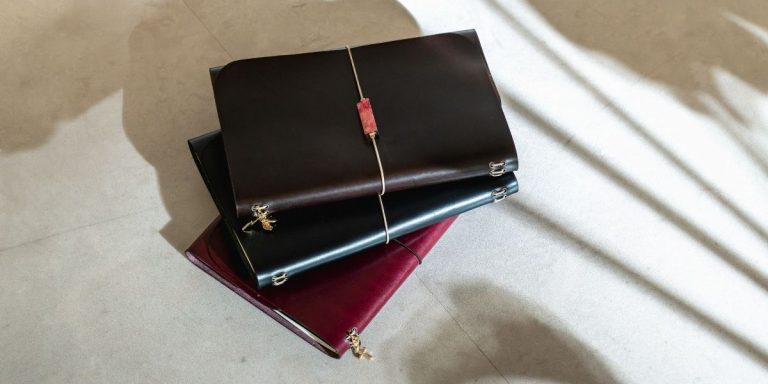
The cover colour is the first thing you see when you pick up your journal. It sets the overall feeling of the object.
Timeless colours that follow you through the day
A customised leather journal lives with you: it goes into meetings, sits on café tables, travels in trains and suitcases. This is why at notāre the colour palette is designed to be timeless, not driven by short-lived trends. These are colours that work in the office and on a weekend away, that go well with jeans, a black handbag or a light trench coat.
You can think of your journal as a wardrobe classic: something that fits every situation.
How to choose the colour depending on how you will use it
A few criteria that can help:
- For work and formal meetings: deeper, more neutral tones usually work best. They integrate easily in a professional environment and do not draw too much attention.
- For personal journaling and creativity: you can choose a colour that calms you down or feels especially inspiring. Ask yourself which tone makes you want to sit down and write.
- For a gift: picture that person holding the journal. If they mostly wear neutrals, basics, denim and white, a classic colour will probably be a safe choice. If they play more with accessories and colour, they might enjoy something that stands out a little more.
Leather as a living material
Leather changes with use. It marks, softens and develops its own patina. This ageing is part of the beauty of the journal. Over time it stops being “a new notebook” and becomes your notebook, with the signs of all the places and moments it has shared with you.
Step 3: choose the colour of the elastic cords
The elastic cords keep the system together, but they also have a strong impact on how your notāre looks.
Tone-on-tone or contrast
There are two main directions:
- Tone-on-tone: elastic cords in colours very close to the cover. The result is calmer and more understated; everything feels like one single piece.
- In contrast: elastic cords in a clearly different colour, for example a dark cover with light elastic or a neutral cover with a more intense elastic.
Contrast gives the journal more visual presence and makes it stand out even when it is closed.
Treating the elastics as an extra layer of expression
Because the elastic cords can be replaced over time, they are a very simple way to refresh the look of your customised journal:
- You can start with a neutral combination.
- Later, when you feel like a change, move to a brighter or more contrasting colour.
It is an easy way to let your journal evolve with you without changing the cover itself.
Step 4: personalise with embossing – initials and meaningful words
Embossing is the most direct way to put a name or intention on your journal.
What you can emboss on your journal
At notāre, embossing is designed to be clear and meaningful:
- You can add up to six characters.
- In uppercase letters, so the result stays clean, readable and timeless.
Some ideas:
- Initials: BMG, LRC…
- Short combinations that only make sense to you.
- Small words that work as an anchor, like NOTES, TRAVEL, DIARY, IDEAS, CREATE or TODAY.
The point is that, when you see it, you remember immediately what this journal is here for.
Embossing finishes: blind, silver and gold
You can choose between three different finishes:
- Blind embossing (natural): the impression is made into the leather in its own tone. It is subtle and discreet; you feel it more with your fingertips than at first glance.
- Silver embossing: adds a cool metallic touch. It is clearly visible, without being as warm as gold. It works very well if you usually wear watches, jewellery or accessories in silver tones.
- Gold embossing: the warmest and most luminous option. It has a celebratory feel and is often chosen for gifts, anniversaries or journals that mark a new chapter.
How to choose the right embossing finish for you (or for a gift)
You can look at:
- Your personal style: if you prefer very discreet details, blind embossing is usually the easiest choice. If you want it to be visible but still refined, silver is a good option. If you enjoy details that catch the light a little more, gold tends to fit well.
- The context of use: for a work journal, blind or silver embossing are often the most natural matches. For a travel journal, personal diary or special gift, gold can add that extra sense of occasion.
- The combination with leather colour and charms: if you already know you want silver or gold charms, it can be nice to let the embossing speak the same metal language.
Step 5: charms and small details that make your journal unique
Charms are small pendants that become the most visible signature of your notāre: the details people recognise before you even open the cover.
Where charms are placed
In notāre there are two main areas for charms:
- Front cover: the perfect place for one main connector that you see as soon as you pick up the journal.
- Side edges: ideal if you want to combine several charms and create a richer composition that appears when you look at the journal from the side.
Charms designed for the side can also be used on the front if you like a bolder look. If you have a very specific idea in mind, we are happy to help you bring it to life.
Choosing charms with intention
You do not need many elements to make a difference. Often, one well-chosen charm already tells a full story:
- For a travel journal: something that evokes the sea, a compass, a journey.
- For a work journal: a symbol that connects you with focus, clarity or calm.
- For a gift: something related to a hobby, a shared place or a small private reference between you.
Special custom charm layouts
When you configure your notāre online, you can select the charms you want to add to your journal. If you have a specific layout in mind, for example one connector on the front cover and several charms on the side, or an unusual combination, you can let us know. All you need to do is add the charms you want while placing your order and write to hello@notareconcept.com with your order number and a short explanation of how you would like the charms to be placed.
This way we can make sure the final result is as close as possible to what you had imagined.
Ideas for customised journals, depending on the person
To make everything more concrete, here are a few combinations that tend to work really well.
For someone who needs an elegant, discreet work journal
- Format: Muse A5.
- Cover colour: a sober, timeless tone.
- Elastics: tone-on-tone.
- Embossing: initials (2–3 letters) in blind or silver.
- Charm: one small, simple charm, or none at all if they prefer a very minimal look.
Result: a customised leather notebook that looks completely at home in any meeting room, while still feeling personal.
For someone who wants a travel notebook full of memories
- Format: Nomad (passport size).
- Cover colour: the one that best matches their backpack, travel bag or belt bag.
- Elastics: in a gentle contrast, so it is easy to spot on any table.
- Embossing: a short word like TRAVEL, NOTES or DIARY.
- Charms: one main connector on the front cover and one or two smaller charms on the side.
Result: a personalised travel journal that practically asks to leave the house with you.
For a special gift that should feel truly thoughtful
- Format: Muse or Nomad, depending on that person’s lifestyle.
- Cover colour: think of how they dress and which colours you see them wearing often.
- Elastics: with a touch of contrast.
- Embossing: initials, a meaningful word or a short date.
- Charms: something that speaks about your story together or about something only you two would recognise.
Result: a personalised notebook that goes beyond “a nice present” and becomes an object with clear intention.
Frequently asked questions about customised leather journals
- How many characters can I emboss on my journal? You can choose up to six characters in uppercase letters, so the result stays clean, readable and balanced on the cover.
- Where exactly is the embossing placed? The embossing is placed on the front cover, in the bottom right corner. It is positioned so it can be seen clearly, without taking over the whole design.
- Can I add charms later on? Yes. You can start with a journal without charms and add them in the future, or change them as your life and projects change.
- Can I change the elastic cords in the future? The elastic cords can be replaced, so your journal can evolve in colour combinations over time while the leather cover stays with you.
- How should I care for my leather journal so it ages well? It is best to avoid direct heat sources for long periods and very high humidity, and not to use aggressive cleaning products. From time to time, if needed, you can give it a gentle treatment with a suitable leather-care product. With use, it will develop its own patina.
How to configure your notāre leather journal step by step
To sum up, customising your leather journal in notāre comes down to these steps:
- Choose the format that fits you best right now: Muse A5 or Nomad passport size.
- Decide on the cover colour, thinking about how and where you will use it.
- Pick the elastic colours to adjust the character of the journal.
- Define the embossing: what you want it to say and which finish you prefer (blind, silver or gold).
- Add charms on the front cover and/or on the sides if you like, and write to us if you have a special layout in mind.
If you want to see how yours could look, you can configure your notāre Muse or configure your notāre Nomad.
The aim is that, when you finally hold it in your hands, it does not feel like just a leather journal, but like your journal.