Guide to choosing your travel journal
Travel journals are often spoken about as if they were all the same, but the term can mean different things. Sometimes we think of a diary for holidays. Other times, it becomes a piece that lives with us in a bag, a backpack or on the desk, holding journaling, ideas, notes, lists and projects in one place.
A travel journal can be more than a notebook for writing during a trip. It can be a system for keeping different parts of your life together, without having to mix everything on the same pages.
In this guide, we look at what a travel journal is, how it differs from a conventional notebook and which details are worth considering before choosing yours: format, material, paper, inner configuration and personalisation.
The intention is not to find the perfect notebook, but one that makes sense for the way you write and that you will want to return to.
What is a travel journal?
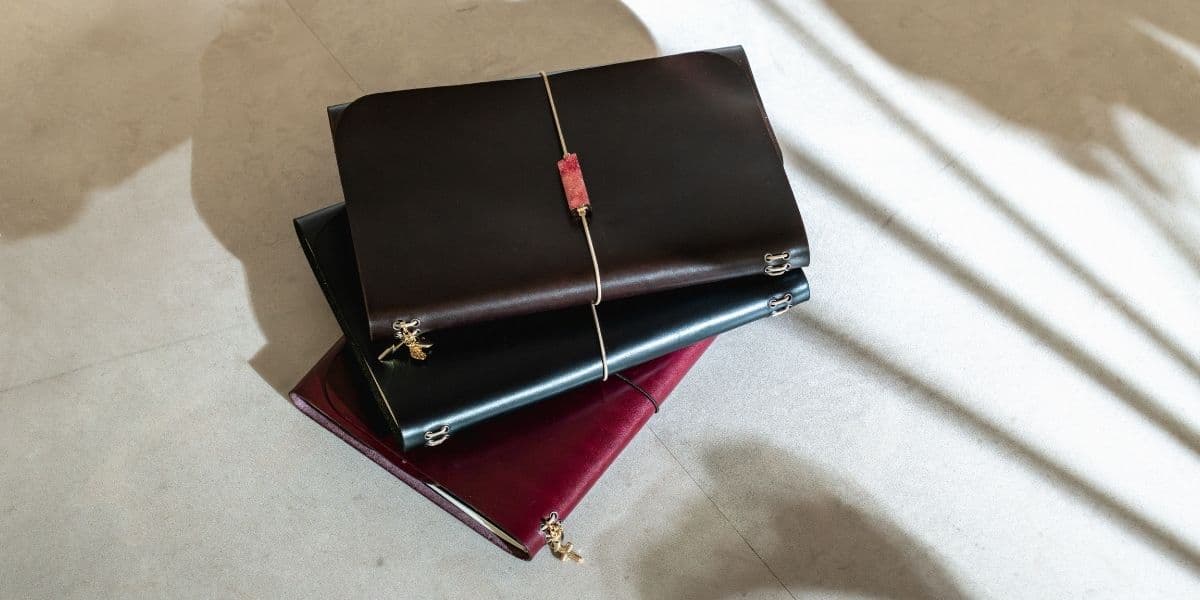
When we talk about a travel journal here, we are not only referring to a diary for holidays. We mean a system: a leather cover with inner elastics that hold different interchangeable notebook inserts.
Inside, those elastics allow you to combine several notebook inserts at once. You can carry one for journaling, another for work ideas, another for lists or one specifically for a trip. When one is full, you replace it with another, while the cover stays with you.
A travel journal can include:
- A leather cover designed to last.
- Inner elastics to hold several notebooks.
- Interchangeable notebook inserts that you can combine and renew.
- A configuration that changes with your moment: everyday notes, projects, travels or personal pages.
Understanding a travel journal as a system helps you choose with more clarity. You are not only thinking about the notebook you are going to fill now, but about a piece that can accompany you through different stages.
Why choose a travel journal instead of a conventional notebook?
A traditional notebook is made to be filled and finished. You start it, write in it, put it on a shelf and buy another one.
A modular travel journal works differently. The cover stays with you, while the notebook inserts change. Over time, the cover gains marks, texture and character, while the inside is renewed according to what you need to write.
It also helps you organise what you carry inside. You do not have to mix personal journaling, work notes, creative ideas and lists in the same block of pages. You can separate each use into a different notebook insert and decide what you want to carry with you at each moment.
A travel journal makes sense if you want to:
- Keep the same cover for years.
- Renew only the notebook inserts.
- Separate different uses: journal, projects, lists, ideas or travels.
- Carry several things in one piece.
- Create a configuration that can change over time.
If you are looking for something more lasting than a notebook that begins and ends, a travel journal offers more continuity. The cover stays with you; what changes is what you need to carry inside.
Choosing the right format: Muse or Nomad
Format matters. You do not write in the same way in a notebook that lives on your desk as you do in one that you carry in your bag, backpack or coat pocket.
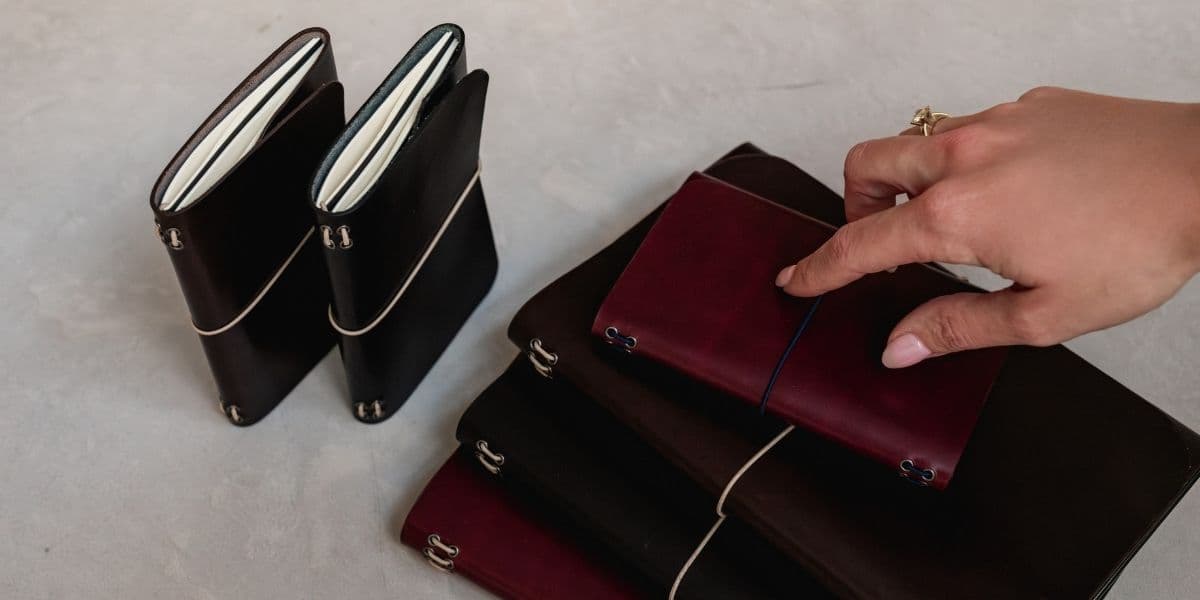
Within the notāre system, there are two main formats: Muse, in A5, and Nomad, in passport size. Both share the same modular structure, but they respond to different ways of using a journal.
There is no single right choice. Some people need space to develop ideas, while others write better in a smaller, lighter format that is always close to hand.
Muse: an A5 travel journal
Muse is the A5 format by notāre. It offers more space per page and is designed for writing, planning and developing ideas with more room.
It is a good choice if you write often, use your journal to organise projects or want to bring work, journaling and weekly planning together in one piece.
Muse works especially well if you are looking for:
- More space to write, think and plan.
- A journal that feels comfortable on a desk, in cafés or by your bed.
- A main piece for projects, notes and personal pages.
- A format with capacity for several notebook inserts at once.
If your journal usually lives near a table and you like writing with space, Muse may be the most natural format for you.
Nomad: a passport-size travel journal
Nomad is the passport-size format by notāre. It is more compact and lighter, designed to accompany you in movement.
It works well as a travel journal, a short daily journal or a small piece for quick notes, lists and ideas that appear during the day. It fits easily into a bag, backpack or larger pocket, making it easier to write outside the home.
Nomad works especially well if you are looking for:
- A small format that is easy to carry.
- A journal for short notes, lists or brief journaling.
- A piece you can open while travelling, waiting or moving through the day.
- A light system for carrying what matters without taking up too much space.
If you want a journal that comes with you almost without thinking, Nomad may be the most suitable option.
Details that matter in a travel journal
Beyond the format, some details change the way your journal feels and works: the material of the cover, the type of paper, the inner configuration and how it feels in your hand.
You do not need to go through an endless list of features. It is enough to look at the aspects that matter most to you.
Cover material
The cover is the main piece of the system. In a leather travel journal, the material matters because it is what stays with you as the notebook inserts are renewed.
Vegetable-tanned leather evolves with use. It softens, gains depth and carries small marks from the places it has been. If you value touch, durability and the way materials change over time, this is an important point.
Type of paper
Paper shapes the way you write. You may not need the same type of page for journaling, planning, drawing, lists or diagrams.
You can choose between plain, lined or dotted paper depending on how you use it:
- Lined paper can help if you mainly write text.
- Dotted paper works well if you mix writing, lists, diagrams or planning.
- Plain paper gives more freedom if you draw, make collages or write in a more open way.
It is also worth thinking about the pens or inks you usually use, and how you like them to move across the page.
Inner configuration
One of the advantages of a modular travel journal is that you can separate different uses without carrying several loose notebooks.
For example, you can configure your journal with:
- One notebook insert for journaling.
- One notebook insert for work or projects.
- One notebook insert for lists, travels or quick notes.
Thinking about this structure before choosing helps you start with a clearer configuration. And if your needs change over time, you can reorganise the notebook inserts, add new ones or replace the ones you have already filled.
Personalising your travel journal
A travel journal stays close to you. You open it, carry it in your hand, place it on different tables and bring it back home.
That is why personalisation is not only aesthetic. It can also give the piece more intention from the beginning.
You can personalise your travel journal through:
- The colour of the leather cover.
- The colour of the elastics.
- An embossing with initials or a short word.
- Charms and small details chosen by you.
The embossing can be discreet: initials, a date or a word you want to carry with you. The elastics and charms add another layer of choice, both visual and personal.
Each notāre is thought for someone. And that idea begins in the details: the format you choose, how you combine the notebook inserts, which colour accompanies the cover and what embossing you decide to add.
A travel journal as a gift
A travel journal can also be a gift with intention.
It makes sense for someone starting a new stage, preparing a trip, changing jobs, returning to writing or looking for a place to organise ideas. When it can be personalised with embossing, colours and details, it becomes less generic and more clearly thought for that person.
It can be a gift for writing, planning, creating or simply returning to paper.
Create your notāre
Choosing a travel journal means choosing a piece that can accompany you for years: a cover that stays, and notebook inserts that you can combine, change and renew depending on what you need to write.
You can start by thinking about your everyday life: how much you write, where you write and what you want to carry with you. Perhaps you need an A5 with more space. Perhaps you prefer a lighter passport-size format. Or perhaps it makes sense to combine both, one for home and one for movement.
It does not have to be a fixed decision from the beginning. It is about choosing a travel journal you want to open, one you can adjust over time and one that helps you return to paper with more intention.
Discover the travel journals by notāre and create a piece made to accompany you.