
How to start journaling and keep it over time
Starting a paper journal sounds simple: open a notebook, pick up a pen and write.
But small barriers often appear. Not knowing where to begin. Feeling there is no time. Thinking every page has to be deep, neat or meaningful. Or believing that if you do not write every day, the habit no longer counts.
Journaling does not have to become another task on your list. It can be a brief, simple space: a few lines to organise what you are carrying, look at the day with more attention or return to paper when you need to listen to yourself.
In this guide, we look at how to start journaling in a way you can keep over time: what usually blocks the habit, how to choose a journal, how to create a simple routine and what to write when you do not know where to begin.
Why starting and keeping a journaling habit can feel difficult
Before thinking about routines, it helps to name what often gets in the way.
Many times, we do not stop writing because we are not interested. We stop because we expect too much from the habit from the beginning.
Some common barriers are:
- Perfectionism: feeling that every page has to be well written, deep or useful.
- Lack of time: waiting for a long, perfect moment to sit down and write.
- The blank page: opening the journal and not knowing what to put down.
- All or nothing: writing for several days in a row and giving up after the first pause.
Seeing these patterns clearly lowers the pressure. Journaling is not a test or a project you need to do well. It is a practice that can adapt to your moment.
You do not have to write every day. You do not have to fill pages. You do not need an important idea before you begin.
Sometimes, it is enough to return to the journal for five minutes and write one honest sentence about how you are.
Choose a journal you want to open
You do not need the perfect journal to begin, but it helps to have a piece you want to return to.
A good journal does not need to be complicated. It should feel comfortable to use, pleasant in your hand and clear enough so that writing does not become another decision.
You can start by looking at three things:
- Format: one that fits the place where you usually write.
- Paper: one that works well with the way you write.
- Configuration: one that allows you to separate uses if you need to.
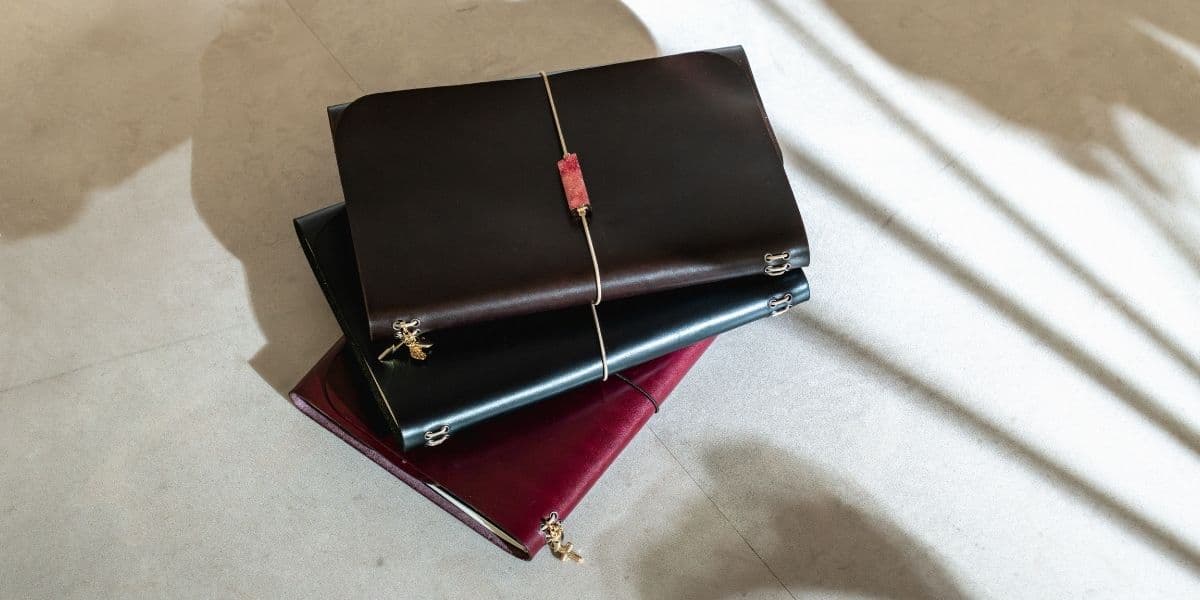
This is where a modular journal can make sense. Instead of filling one notebook and starting again from zero, you keep the cover and renew the notebook inserts according to what you need to write.
You can carry one notebook insert for journaling, another for work notes and another for lists or ideas. Each thing has its place, while staying together in one piece.
Muse or Nomad for starting to write
Within the notāre system, there are two formats: Muse, in A5, and Nomad, in passport size.
Both can be used for journaling, but they support different moments.
Muse: more space to write
Muse is the A5 format. It offers more room per page and works well if you like writing slowly, developing ideas or doing weekly reflections.
It may suit you if:
- You write several lines at a time.
- You like having space to think on paper.
- You also want to use it for planning, projects or personal notes.
- You usually write at a table, at home or in a café.
Muse can become your main journal: a piece where journaling, ideas and planning can live together without feeling limited by space.
Nomad: writing in movement
Nomad is the passport-size format. It is more compact, lighter and easy to carry.
It may suit you if:
- You prefer writing a little, but often.
- You want to keep it in your bag, backpack or pocket.
- Short notes, lists or loose sentences work well for you.
- You write while travelling, waiting or during small pauses in the day.
Nomad works well when the habit needs to stay close. It does not take up much space, but it gives you a clear place to return to paper when an idea appears or when you need to organise something quickly.
Create a journaling routine you can keep
Most journaling attempts fail because they start too big.
Writing every day, for a long time and with a demanding structure can work for a week, but it does not always fit into a life full of changes.
To begin, make it small.
You can choose:
- A likely moment in the day, not a perfect one.
- A short amount of time, such as five minutes.
- A simple structure, so you do not depend on inspiration.
Some moments that often work:
- After coffee.
- When you close your laptop.
- Before going to sleep.
- At the beginning of the week.
- On Sunday afternoon, as a small review.
It also helps to leave your journal where you want to use it: on your bedside table, your desk, a side table or inside your bag.
The habit is not built by never missing a day. It is built by returning many times, even after several days without writing.
What to write when you do not know where to begin
One of the simplest ways to keep journaling is to have a few repeatable structures.
You do not have to invent something new every day. You can use the same questions for several weeks and let the answers change with you.
Three lines about the day
Write three sentences:
- Something that happened.
- Something you felt.
- Something you want to remember.
It is a simple way to close the day without having to explain everything.
What is on my mind
Open the journal and write a list without trying to organise it too much.
It can include tasks, worries, ideas, pending conversations or things you do not want to forget. The aim is not to solve everything, but to take some of the noise out of your head and bring it to paper.
One question a day
Choose one question and answer it for a few minutes.
Some ideas:
- What do I need today?
- What is taking up too much space?
- What do I want to take care of this week?
- What can I write down before moving on?
- What was worth remembering today?
A small check-in
You can also write a brief note on how you are:
- Energy: high, medium or low.
- Focus: clear, scattered or tired.
- Body: light, tense or slow.
- Something that gave you calm.
- Something you want to carry into tomorrow.
This type of check-in works well when you do not want to write much, but still want to keep the gesture of opening the journal.
Do not turn journaling into another obligation
Journaling loses its meaning when it becomes another demand.
You do not have to write every day for it to count. You do not have to fill pages for it to matter. You do not need to look back and make up for the days you missed.
You can return to the journal without explaining anything.
One sentence counts. A list counts. A messy page counts.
What matters is that the journal remains a space you can return to, not a place where you measure yourself.
Create your notāre
Starting journaling is not about changing everything in a month. It is about creating a small, steady space where you can write what you think, organise what you feel and return to paper with intention.
A well-chosen journal can help support that gesture.
With notāre, the cover stays with you and the notebook inserts can be combined, changed and renewed according to what you need to write. You can choose Muse if you want more space, Nomad if you prefer something compact, and configure the piece with the details that make sense for you.
You can also join the notāre newsletter to receive writing ideas, journaling prompts and resources to begin your journal with less pressure.
You can start today with three lines. The rest will find its rhythm.